
Meeting Stan Getz
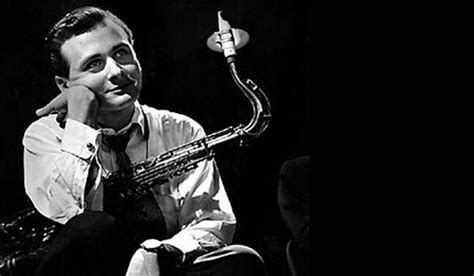
Back when I was an aspiring teenage musician in Utica, New York, in the mid-‘70s, a friend introduced my eccentric progressive rock band Zuir to her roommate at an elite East Coast boarding school, who’d tagged along to Utica for the winter holidays. We all quickly took to Pamela, who in turn was keen on our music. One day Pam suggested that we send a tape to her dad, as he might be able to help advance our fledgling career. I asked what her dad did; she replied in a ho-hum tone that he was a jazz musician. That piqued my interest, for I was worldly enough by then to understand how rare it was to be a self-supporting jazz musician in this world.
What was Pam’s last name again? That’s right, Getz. Sounds vaguely familiar.
I went home and started thumbing through the stack of Downbeat magazines my older brother Woody had beneficently subscribed me to, and there he was – Stan Getz! – listed second in that year’s balloting for the Downbeat Hall of Fame.
Pam’s dad just happened to be one of the most distinguished saxophonists in the history of jazz. I was mighty impressed and shared the news with the guys, but the distance between Stan Getz and Zuir seemed pretty daunting so we didn't follow up. A year or so later, the band moved to Seattle right after graduating from high school to test our fortunes with the encouragement of my brother Woody. We had no local connections beyond Woody, but we did have access to a deluxe rehearsal space loaded with high-end sound equipment, a demonstration studio for a commercial audio dealer. Through a mutual friend of Woody’s, the company agreed to let us rehearse on their soundstage a couple of times a week, a pretty posh situation. We put the time to good use making a proper demo recording with the explicit intent of sending it first to Stan Getz. What was there to lose?

Once satisfied with our efforts, we packaged up the reel-to-reel Zuir demo tape and addressed it to Stan Getz at his residence in Irvington, New York, care of Pam, with an explanatory letter. We walked uphill to the Post Office with the parcel but found it closed for some minor holiday. Oh well, we’d come back tomorrow. But incredibly, a few minutes after we got back home, a breathless Woody showed up at our door with news that Stan Getz was playing in Seattle that very night. How’s that for serendipity?
That evening we walked down to the venue, a long-vanished jazz club called Pioneer Banque in Seattle’s Pioneer Square historic district, to waylay our hoped-for benefactor. There was just one problem: We were too young to get into the club. (We’d naively moved from New York state, where the drinking age was 18, to 21+ Washington.) We had no choice but to hang by the subterranean stairway entrance and hope to intercept him when he turned up – and he did. I’d been deputized to break the ice; in a tremulous voice, I said, “Mr. Getz, we’re friends of your daughter Pam and have a band here in Seattle. We’d like to give you this tape of our music and see what you think.” He brightened instantly at hearing his daughter’s name, saying, “You guys are Pammy’s friends? Come on into the show as my guests!” When we explained the age barrier, he huffed, “Nonsense, I’ll get you in,” but the staff wouldn’t let him sneak in minors.
We tried to hand over the tape, but he said he’d much rather see us play live. “I’ll be in town for a few days. You guys have any gigs happening?” Of course we didn’t since we were too young to play in licensed clubs but too embarrassed to say so. It was a wholly unexpected request coming from a musician of such stature, but some quick thinker among us said, “No gigs right now, but you can come hear us at our practice space if you like.” Unbelievably, he agreed. We were thunderstruck – and instantly terrified.
I quickly contacted Woody and the studio owners with the news, and they were as rattled as we were. Getz had asked us to call him the next day to set plans, but after feeding multiple dimes into a pay phone with no response, a couple of the guys simply walked down to the hotel where he was staying and had the front desk ring him up. Big mistake. We could be forgiven for not knowing that Getz had a famously volcanic temper and was definitely not a morning person (he was still abed around noon), but my pals got a minor tongue-lashing before he mellowed somewhat and reaffirmed his interest in seeing us play. We would pick him up at his hotel the next day and drive him out to the studio.
I shake my head at our audacity at this remove, but the saxophone legend who introduced much of the world to one of the most-played tunes in history, “Girl from Ipanema,” and so much else assented to squeezing into our weathered International Travelall with five of us for the ride across town to the rehearsal studio. My brother brought along his jazz-nut friend, and the guys who worked at the studio actually showed up wearing suits, some on their days off. Now came the deflatingly anticlimactic moment: Near-sick with audition butterflies, we started playing a relatively shaky set of Zuir tunes – the tape was way better – before Getz summarily cut us off after the second number. He emanated the vibe of an important personage whose time had been wasted, and was impatient to leave, a most uncomfortable scene for all at hand.
Back in the banged-up truck, “The Sound” (as he’s known among the jazz faithful) leveled with us: “Look – you guys play acid rock. I don’t like acid rock; I walk out on acid rock. But I’ll give you guys this: You’ve really got some balls inviting me over here like this. I appreciate that you’re Pammy’s friends and you seem like pretty nice guys and decent musicians, so I’ll tell you what, my door’s always open once you get some experience and maturity under your belts and feel ready.” It was very gracious of him to say so under the circumstances, but as the humbling experience sunk in over the coming weeks, our attitude became “Fuck this duffer, he doesn’t understand our music – we’ll be damned if we reach out to him again.” Right.
Zuir eventually returned to Utica and evaporated due to lack of opportunities and the exigencies of encroaching adulthood. In the meantime, I underwent a change in musical direction, having fallen under the spell of modern jazz players like John Abercrombie and Ralph Towner, and started composing in a similar vein.
In 1979, en route to Germany to record an album with Earthstar – an unlikely U.S. entrant in the then flourishing Krautrock scene – I spent the night at Pamela Getz’s carriage house residence on the Getz estate in Irvington before the next day’s flight out of JFK. Pam’s husband Scott, another friend of mine from Utica, asked what I’d been up to musically. I’d brought a ¼-inch demo tape of my recent music with me to pursue my own opportunities in Europe, so Scott suggested that we go up to the main residence to listen to it on a proper reel-to-reel player. A few minutes into the first piece, a wistful melancholic tune played on acoustic guitar with an electric overdub, who should walk into the room but Stan Getz himself. (I’d had no idea he was around.)
“What’s happening here?” he inquired.
Rattled, I sheepishly replied, “Remember Seattle?” A smile of recognition crossed his face.
“You guys – the acid rock band! What are you doing nowadays?”
“You’re listening to it,” I gulped, fearing the worst.
He stopped and listened closely for a minute or two. “This is a complete change of direction. That’s more like it!” He seemed sincere and asked me to play the piece twice more, then asked what my plans were. I explained that I was heading to Germany the next day for a recording session, then staying on for a while to explore my options. He thought a moment, then asked his wife Monica to bring him pen and paper, on which he generously wrote me an introduction to bring to his friend Peter Herbolzheimer, a distinguished trombonist who then led the NDR (North German Radio) Big Band based in Hamburg, not far from my destination outside Hannover. It read:
“Dennis is a young, very talented musician that I’ve followed for several years. I think he’ll develop into something quite interesting – please do whatever you can to help him.”
I was stunned. In retrospect it was the greatest compliment I’ve ever received.

I called Peter Herbolzheimer soon after I arrived in Germany and told him I’d brought a message from Stan Getz. That apparently got his attention, for he asked me to meet him when he disembarked from a flight the very next day at the Hamburg airport. We sat in his car in the airport parking lot and listened to a cassette copy of my demo. Peter evidently liked the music as well and asked what I had in mind next. I told him I was fishing for a record deal, an unrealistically lofty aim viewed from this distance. (Indeed, I was rebuffed by ECM around this time.) Peter wisely thought it made better sense to start gigging and building a reputation first, then – if I understood him correctly – made me an overture to join the NDR Big Band! I knew in my bones that I was far from ready for that, being a shitty sight-reader and needing far more seasoning in general, so it never went any further than that, but still. We ended up going to legendary Hamburg jazz venue Onkel Pö’s Carnegie Hall to see some of Peter’s friends play, after which, at Peter’s introduction, the drummer for prominent German prog band Triumvirat kindly put me up in his apartment.
What’s missing from this story is how little awareness of Stan Getz’s music I had back when I encountered him, apart from the obvious Bossa Nova classics. Years later I felt the urge to check out the magnificent LP Focus, on which Getz the soloist navigates challenging charts with effortless aplomb alongside a string orchestra led by composer/arranger Eddie Sauter. Astoundingly, Getz had never sussed out the scores ahead of the session but improvised the entire album right from the downbeat. I wept at the music’s beauty and Stan’s melodic mastery, ashamed that it had taken me so long to grasp his greatness while pursuing my own advantage. I vowed to express my appreciation if I ever got another chance to meet him, which sadly never came.